unexpectedmagazine
Overcoming Stereotypes since 2025
UNEXPECTED MAGAZINE
Seeing Past Homeless Stereotypes
Letter from the Editor
When my disability led me to become homeless, the first thing I noticed was that classism is alive and well in the United States in 2025. I was struck with all the stereotypes “normal” people had about us. I was told I must have been in SpecialEd:
I have two Master’s degrees, have worked for Microsoft and Seattle Parks Foundation, am a 4.0 student, and have 12 poetry publications in literary and online magazines. When I was put in a living space for the homeless, most everyone I met was either musically gifted, had an incredible family, was a fierce community advocate, or super amazing in some way.
I have been writing professionally for 18 years. When someone recommended I give back to my community, I decided I wanted to tackle our toxic culture of stereotypes and shame. I want to replace it with compassion.
I hope you are able to see that the people who contributed to this magazine, while struggling, or helping those who are struggling, are phenomenally talented community members. We need to be given more resources for our survival.
4 Poems
by Drew M.
Today is a simple day
A day to be remembered
A day not to be forgotten
One truth to one’s desire
Is the outcome of possibilities
Forth come greatness
I like pickles
I like rice
I like to wear skirts
In the summer
The wind
The trees
The golden bee
Stamps the flower
With it’s all setting being
We fall away in the nights sky
As we come together in a nice fog
Thus all we can do is love
Now being it such like I do my mom’s
Drew is a fierce friend to their peers. They make an impression with their glamorous style, in every community they enter. Drew is a hard worker, but prioritizes LGBTQ rights over a direct path to wealth. Regardless, Drew sets the tone of their community and boldly takes the leadership in making lifegiving connections.
Netflix Filmmaker and Local Trustee Spotlights Community Advocacy
By Sara Grimes
Trustee Gabriel Medina is a horror movie producer and director. He serves the Pajaro Valley Unified School District (PVUSD) and is a lifelong resident of Pajaro Valley. Medina has a background in filmmaking and community advocacy.
I first found out about Trustee Medina when I was taking classes at Avenues, an outpatient program, for people with mental health and substance use disorders.
The program, based in Pajaro Valley, took us to the Watsonville library for an inspiring community talk, with Medina. He discussed his passion for film and education. What stood out was his dedication to finding success through community advocacy.
Role models were important to Medina growing up. First, the mentorship, by his Grandpa, for high school class projects, helped him beat out the seniors as an underclassmen in a school film competition. That victory helped him build confidence to start community projects and become a producer and filmmaker.
Next, he combined forces with two documentarians and one narrative fiction creator. He led them in getting funding from the city of Watsonville. Soon, he took on a leadership role as the producer. His narrative junkie tack and college track gave him an edge over his two documentarian friends.
He was blessed with other great mentors in college. He accumulated so much momentum, he ended up being propelled to Los Angeles tiers of influence. Soon, he was working on Netflix productions with Oliver Stone and rubbing elbows with Salma Hayek.
After becoming disillusioned by the hierarchies in LA, he returned to Pajaro Valley. Right now, he is working on a magical realism film with religious elements to contrast elements of light and darkness.
To this day, he is extremely community-driven and one of his seminal films is about robots taking jobs from migrant ladies. This is social commentary about the saturation of tech being a divisive force in our communities.
THANKS FOR PARTNERING WITH US TO END HOMELESS AND MENTAL ILLNESS STEREOTYPES, NAMI SANTA CRUZ!
Poem in Spanish
By Carlos Marquez
Deportista ilustra al Mundo entero universal,una forma de adoración por El amore de las naziones demostrando en action en de total El poder de la fuerza de fe por ganar y ganarsela en cualquier situation critical creando paz al rededor del Mundo en El sports deportidos. Dando una oportunidades para demostrar y poder ganar en El juego del amor al deporte I para siempre saver de esta manera de convivir sin Guerra en El Mundo entero con pas , War in the nation s rearview mirror international ,estado,Lugar,ciudad,pueblo,país,en las Olimpiadas Y apreciando juntos con otras naciones natural mente en El deporte , I mas por venir mejorando en El Mundo en una mejor vienestar sin Guerra s , Universal mente juntos conversando en comprendimiento , I cada uno de cada persona en El juego del deporte por El amor de hacerlo de corazon por la Paz en El Mundo sin Guerra se esta haciendo UN paraiso por El deporte olímpico global Paz al deportista Sportster .
Sportster sports illustrated around the world, a universal adoring of the love of the nations to Nations, a showing, an action of faithfulness, strength, endurance, and most likely, for the faith to win and winning: situation critical. When situations are critical, creating a world of peace to piece together, and giving us a chance to show up and game play, forever bringing this world, with less war in this world of peace. War in the Nations, rear view mirror, national State place town and all countries: fourth ways Olympic League and phrasing together other National sports. More to come to make this world a better place of universal languages spoken, understood, and each and every one of us in this game of love to do so making this wall a paradise. Just being a Sportster life is a good Teamster to make this life a better world of peace; they are of action.
Bio
Carlos Marquez is primarily a community-builder. He has been spreading light in the Pajaro Valley for the last several years. He is a role model for addicts overcoming trauma. He is a barber and uses his styling skills to spread joy to members of his city. He is bilingual in Spanish and English and writes about peace. He is passionate about sports.
IF YOU ARE ENJOYING OUR MAGAZINE, PLEASE SHARE WIDELY WITH FRIENDS, FAMILY, AND COMMUNITY MEMBERS! THIS IS THE BEST WAY TO GIVE BACK!
Bi-Certain
You make a melancholy silhouette
playing solitaire alone on the patio with
Lips made ruby from wet colored pencils
and eyes tinted blue by the same
Process.
“Do you want to kiss me?” I ask you with a smile,
drunk on Moon Glow
You stare at me with analytical eyes that
Burrow into my soul with pain + playfulness
I laugh, “I’m bored.”
“Bi curious,” you say,
Undestsand[ably]ing
As if this was an understandable
weakness
“You can kiss me on the neck,” you compromise.
I don’t love you, only, the day.
I kiss you on the arc of your
Neck. It is soft,
Majestic and graceful.
You offer to kiss mine.
It is soft and lingers. I dance to
“Beautiful Mistakes” and “Too Sweet”
Maybe, I am “Bi Certain.”
Bio
Sara Grimes has a Master’s degree in Poetry from UC Riverside. She was a poetry editor at the Coachella Review for a year. She has 12 poems published in literary and web magazines with wide audiences.
Author’s Note
I used to think I could only love men. However, when i was in women’s jail, there was such a strong community of women. We were taking poetry classes together, knitting together, and sharing artwork together.
One day, I meet this gorgeous girl who brings this wonderful free spirit into this caged situation. I was smitten. That’s how ‘Bi-Certain’ came about.
Thank you SO much for reading! This has truly been a community effort to build partnerships in the community to confront stereotypes about homelessness. Stereotypes are debilitating. A little bit of compassion goes a long way. Please contribute to keep our (maga)zine going!
Donations:
Venmo |Sara Grimes @Unexpected_Magazine
Sara Grimes Portfolio
SARA J GRIMES is a confessional poet living in Washington state.. Reading her poems feel like being let in on an intimate secret, and they are!
She was the sub-Editor and Poetry Editor for the Coachella Review for 2 years. She studies relationships and is interested in how people tick when in a collision course with their hormones! She loves listening to music (she supports Indie records). She has a magazine called Unexpected Magazine, where she works relentlessly for community advocacy.
SJ, as she would like people to call her from now on, is super grateful for all the poetry publication that took a risk with her nutty rhetoric.
SJ is deeply impacted by her time in Seattle and the Pacific Northwest and themes of isolation and melancholy can be found lingering in her poems. She is a lyricist.
- The Cultural Daily
- Aloka Review
- The Odyssey Mediterranean Journal
- Convenient Amnesia Review
- Atomizer Poetry Book Review
- 7 Poems Published in Edge of Humanity Magazine
5 Haikus
by Sara Joy Grimes
Escape Artist
You were pink, wrinkled,
Weird. You escaped from your band
Like a true artist.
Four.
When your dad exclaimed
“I’m the pink princess!” you cried
And ran to your room.
Dare to be warmed
Coffee and a view
Of the haunted swamp, swirl in
My cup and comfort me.
Bouncing Jays
Up and down, up, down
Bluejays sway from limb to limb
Spirit animal
Proximity
I love the smell of
deodorant, fresh morning
Scent, close to my heart.
Pictured Below (so as not to be confused with prior author) is Judy Gittelsohn
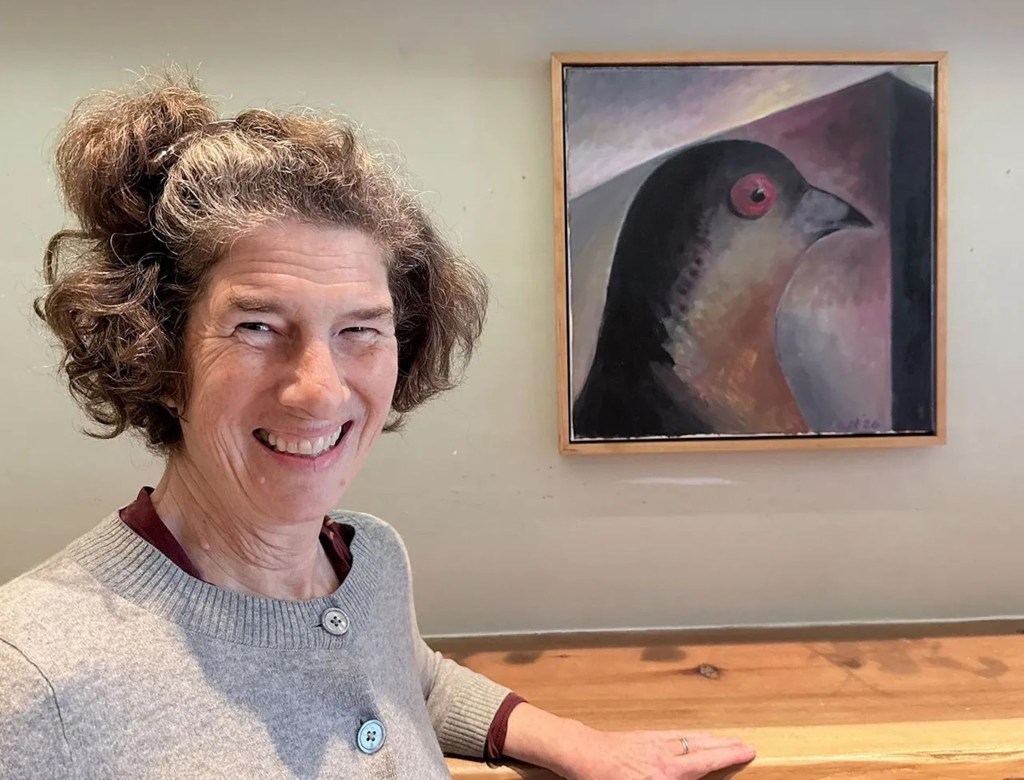
Photo: Judy Gittelsohn at her art gallery.
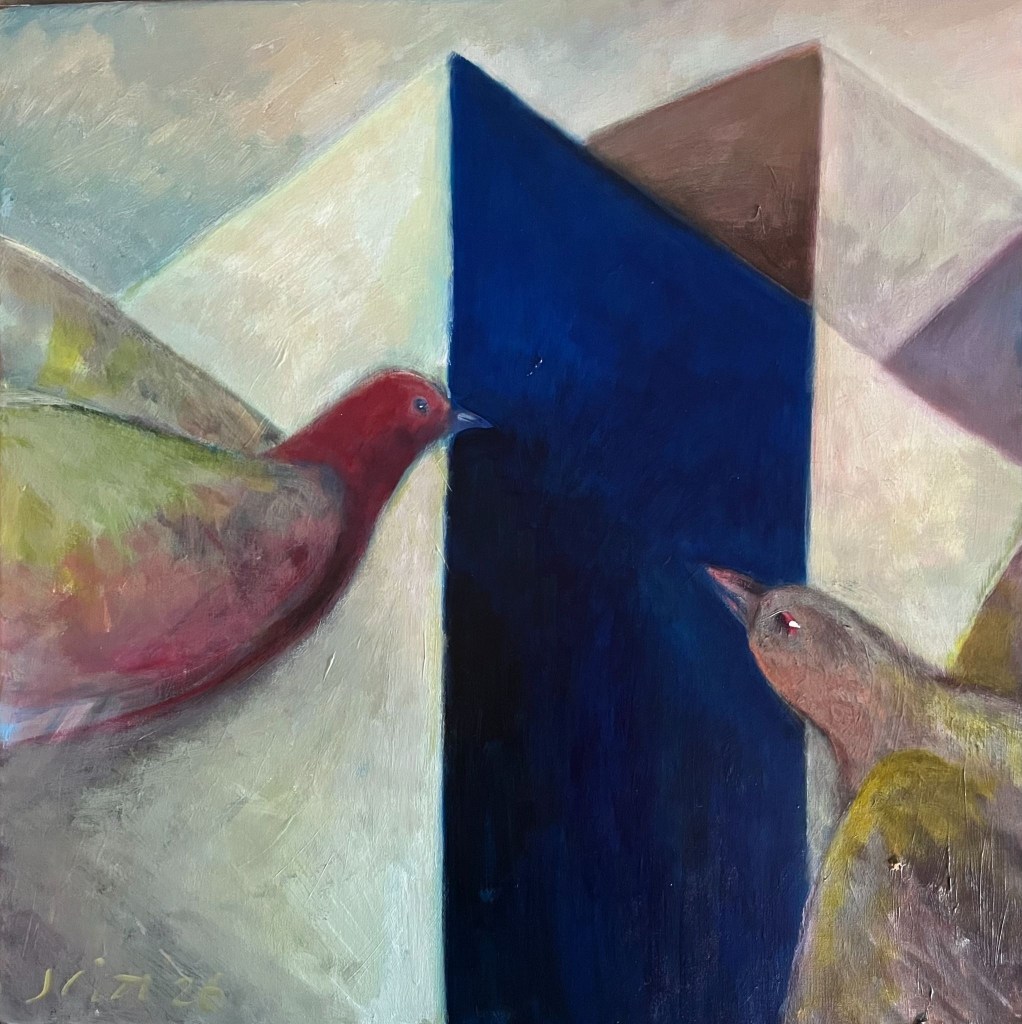
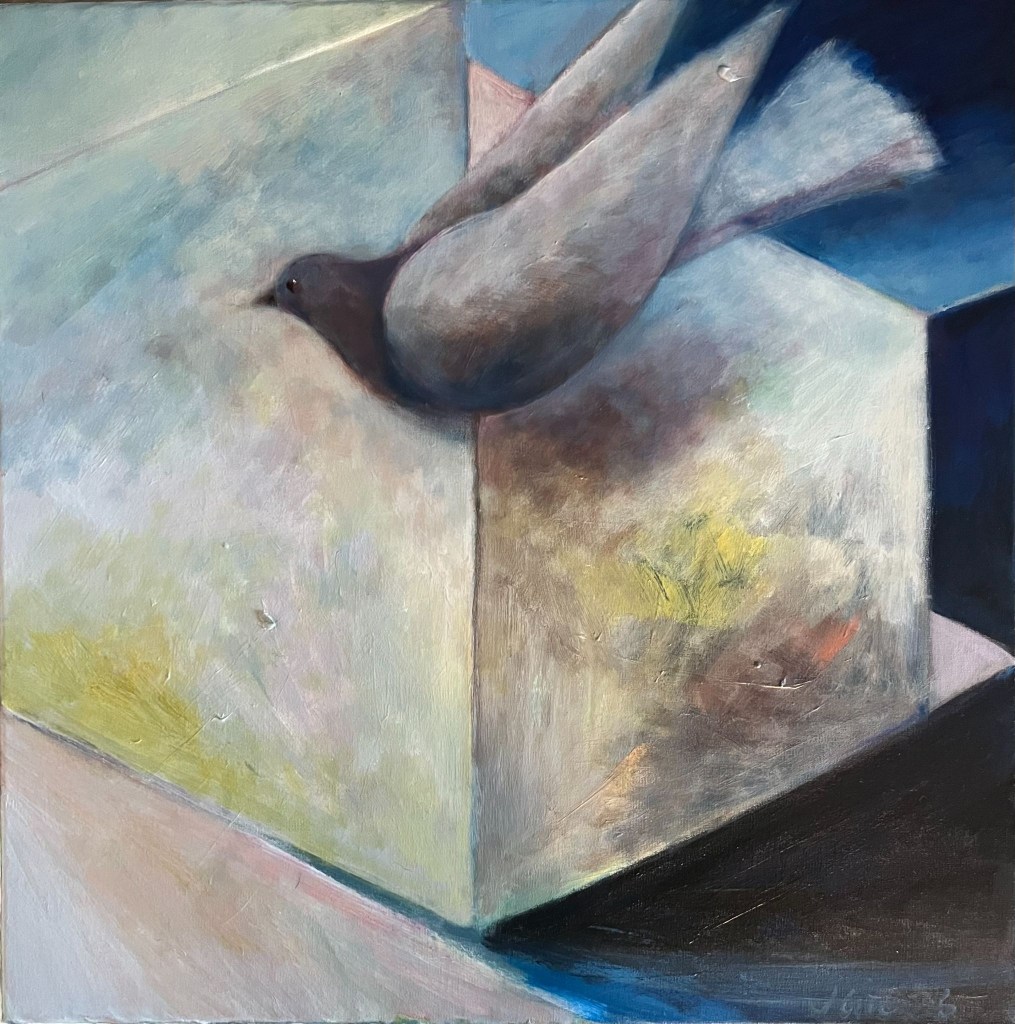
UNEXPECTED MAGAZINE: ISSUE 2 “BIRDS AND BUILDINGS”
Judy Gittelsohn is a truly extraordinary, humanizing voice in the West Coast art scene. She was recently covered by the SF Chronicle for discovering an historic art piece in her backyard.
1. How would you define your genre of art and materials used?
My art is best described as symbolic figurative work, created with brush on canvas. While the pieces depict faces, they often lean towards a less literal, more abstract representation of a person. I consider myself a traditional painter in the sense that I use a brush and apply paint in a conventional manner.
2. What are a couple highlights of the art scene in Santa Cruz and SF?
In Santa Cruz county, and previously in Santa Clara county, I had studios where I taught art to people with special needs. I loved this work because these individuals might have lacked abilities, but as a group – their imagination and capacity to create and do their best was awe-inspiring. My work in Watsonville focused on community-building through art.
San Francisco, in the 1970s, was a truly vibrant and creative period for me, deeply intertwined with art and music. It was a highlight, and I’ve reconnected with people from that time, 28 years later. We share values and interests. I am home with my people.
In Watsonville, people often asked whether my art was just a hobby. San Francisco, however, offers a cultural environment where my identity as a painter is readily recognized and accepted; I don’t have to actively build that community, it’s already there.
3. What are some downsides of Santa Cruz that made you want to move?
The primary difference is that San Francisco feels like home to me, a feeling I wish everyone could find. It was quite a shock to discover that some of my neighbors in Santa Cruz county were Trump supporters. My approach to art and communication is influenced by figures like Kay Ryan, who uses slant alliteration, abruptness, and brevity, and Hans Hoffman – who said “the ability to simplify means to eliminate the unnecessary so that the necessary may speak.” I aim for sentimentality without being superfluous.
4. What was it like working with special needs individuals?
I worked with adults with developmental disabilities, NAMI (National Alliance on Mental Illness) patients, people with Alzheimer’s, seniors, at risk youth, in jails and in group homes and foster care youth and EVERYONE did their best, and their willingness was truly inspiring. I also worked as an educator for Golden Paints, teaching people how to use their materials. I believe in utilizing all available strengths, even and especially in challenging situations. When we’re in vulnerable moments, it might be difficult to see past the present, but those moments might be some of our most creative and those experiences might lead to significant growth
5. What is one thing you learned from them?
When I paint a head, I fill it with a precise emotional moment or longing. The clarity and singularity of a head can harken back to hoping for something or listening. Painting is an act of being the director and listening and responding.
Robert Hughes once said that art is a way of addressing feeling, making the world whole, and closing the gap between “you” and “not you.”
6. What inspired the “Unsprung Spring” theme in your former showcase?
It attests to the fact that spring takes you by surprise.